
I just started as Director of Social Media at Unison Agency in Washington’s historic Georgetown. One of my perks is getting to work with Executive Director of Strategy, Andrea Fabbri. He’s a strategist’s strategist. During a meeting on Friday he quipped, “a website is a trap — or should be.” I had never thought about it that succinctly. It’s true! “It’s Wabbit season, and I’m hunting wabbits, so be vewy, vewy quiet!”
Charities know it takes seven touches to garner a donation. Big brands know they need to fill the skies with advertising ack-ack if they want to get into our consumer heads. Parents know that repetition is the secret to teaching their kids. The same thing is true when it comes to your website.
Everyone’s obsessed with drawing visitors to their sites and online social media properties through advertising, SEO, marketing and PR; however, when the stars align and someone actually clicks through and comes into your sphere of influence, do you have a collections strategy? Do you have methods for trapping these valuable, pre-filtered, and already-interested prospects? Well, you should, because you can’t expect someone who’s doing an initial reconnaissance of your work and services to necessarily remember to come back later when they’re ready to take the leap and hire someone. Bookmarks are passé and our memories are addled with too much to do, too many sites, and too much information.
When someone finally takes your bait and lands on your site, having the perfect site is only the first step. The next step is to trap them.
When I talk about trapping your prospects, what I mean is offering them a compelling method for keeping in touch that’s stickier than a contact form or a hyperlinked email address.
There are a number of traps you can lay — and you should consider them all if you have the commitment, time, and resources to maintain them all.
1) Email List/Newsletter — Are you subscribed to any newsletters? I am subscribed to the newsletters of Seth Godin, Chris Brogan, CC Chapman, and Christoper Penn. They’re all kings of the email newsletter — and I am never disappointed. I can’t tell you how many of my blog posts were directly inspired by morning emails from Godin and Brogan. I have never started one myself as this method demands full commitment and full seriousness. Each newsletter, even if it’s “just” a blog-to-email newsletter, needs to be insightful, germane to the subject, and valuable. Why? Email is a hot-potato and can never be abused or it’ll be ignored, spam-boxed, blocked, reported, and — in the best scenario — unsubscribed. With a newsletter, you need to become the best parent possible: your newsletters need to go out exactly when you say they will, at the frequency you promise, and with a consistency of quality, voice, generosity, and vision that cannot be done in half-measures. At the very least, you can use Feedburner as a way of offering up your blog posts as subscribable by email; or, if you’re really willing to commit to the newsletter as a method of keeping in touch, MailChimp seems to be the way to go these days; however, AWeber and Constant Contact seem to still have strong market shares. Chris Penn is a maestro. I just popped over to check out his personal brand site and after reading one post, up popped a request to join his newsletter, Almost Timely News:
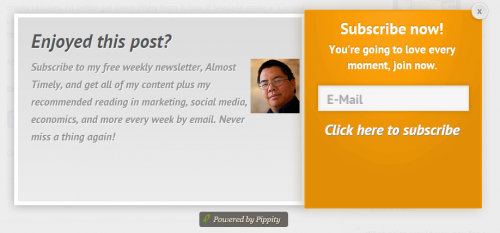
2) Valuable Content Offer — Instead of a content-based newsletter, many sites offer white papers or exclusive content from their sites. This can be useful; however, it suggests to visitors that they’re soon to receive an aggressive sales call from a sociopathic salesman. It may well be too much commitment for the casual peruser. It might be something you might want to add for the serious visitor; however, don’t make this a barrier to seven touches. And, if you have no activation plan and are just collecting name, company, email, and phone number, then you have a block to your marketing plan. Plus, since you don’t even have a tacit agreement in place as to how you’ll be contacted in the future, how often you’ll be contacted, and what you’ll be sent, you need to err on the side of under-messaging. Whatever the offer is, the visitor needs to perceive a value-for-value trade between their contact information and the lure you’re proffering. So, for example, if you have an eBook or White Paper that you’ve charged for in the past, you might re-purpose that document as an incentive for your visitors to share their personal information. I must warn you to err on the side of being too generous. Give ’til it hurts. When it comes to boring corporate websites, there’s really no such thing as a freeloader. Everyone who visits is there for some reason, be it doing initial recon, due diligence, or even competitor analysis. So, no matter what your gift “costs” you, it’s a worthwhile investment in your sales channel and business development strategy. I would say it’ll win you more income, over the course of its life, as a free incentive on your website than it ever would as an eBook on Amazon.com.
3) Social Media Subscriptions — If you’re doing social media right, you’re using social media as a powerful way of both remaining in the minds of those who have dared to cross your path is the past but you’re also working on building a trust relationship with each and every friend and follower — and they are paying attention. Social media is a trap. And if not the trap, it is a lure that is an essential part of the path to the seven touches towards conversion. But you need to learn to detach yourself from the outcome and just spread out as many toys as possible, stand back, and don’t be surprised when your visitors turn meter sticks into swords and cardboard boxes into forts and don’t remotely follow your well-laid social media plans at all. It’s our job as strategists to adopt, populate, maintain, and respond to as many social media platforms and services as possible — including YouTube, Pinterest, and Slideshare in addition to the usual suspects — and then see, over time, what works best for you, bearing fruit, and what just shrivels on the vine, time after time. The true results might surprise you — your best performers may well not be Facebook, Twitter, and LinkedIn, as you may expect. Personally, my biggest performers are, strangely enough, Pinterest and Slideshare. Who would’ve known? In the past, it’s been StumbleUpon. Wouldn’t have seen that coming. Be sure to spread broadly across quite a few social networks and sharing platforms — and spend the time and resources to do it right — before choosing your favorites. Be sure to allow your web metrics and and referrer data to define which platforms those are and not just the ones you like using the most — that’s hubris.
4) RSS Subscription — At the very least, your site should have a news section. Most companies do a pretty good job of posting all their wins, news, press, and announcements onto their site. Sadly, too many of these are static updates. New announcements could offer the same tools as a blog: RSS feeds, subscribable via newsreader, are a good way of creating content that is accessible and readable to both passing visitors as well as Google’s indexing spiders and bots. In addition to being easy to subscribe to, having your publicity accessible via RSS also means that it is subscribable via email by using an RSS-to-email service like Feedburner’s email subscription service (there are a lot of services like this, most free). Finally, if you turn your static News section into blog-like posts, you can easily add social media share and submit buttons, extending these news items from just site-based brags and updates to social media-shareable content that is nearly frictionless to share via Facebook, Twitter, Google+, Pinterest, reddit, digg, Newsvine, StumbleUpon, or even Tumblr. “Who would want to share my press release to social media?” you ask? Well, that’s not your concern. Your concern is making things as easy as possible. Don’t forget: you’re laying down traps here and there’s no guarantee that all of your prospects love cheese. It’s essential that you not only make everything simple, painless, accessible, interesting, compelling, and fun; but, you also need to make sure you’re not to attached to how your visitors are going to behave.
5) Retargeting Code — I don’t know enough about retargeting — and everything I know I learned from Adam Viener of imwave. What I know is this: you can procure a bit of code from Google AdWords that you can embed on your sites and blogs that will insert a cookie into the browser of everyone who visits. That bit of code keeps tracks of where you are, for Google, and you can then target ads to all the people who have visited any of the sites you have installed this code on. So, when you spend your ad dollars, your ads will only display to those who have visited you, effectively stalking them across potentially any and all online content that serves Google ads. Additionally, you will only pay for the clicks as they are displayed to the visitors who have been to your sites at least once. And you should input that code onto your sites and properties even if you don’t plan to use them right away as they can have a life cycle of over a year. So, put them in now, as acquired on your Google AdWords account, and then try some experiments over the course of the year. You can have different code snippets for different sites or you can have different retargeting ad campaigns. If I remember correctly, you can implement logic to your retargeting campaign, targeting different ads after different behaviors are performed such as buying something, filling out a form, or whatnot — and each time another step into the trap made, the ads can change according to where they are or how close to converting to clients they are. It’s really quite amazing and is responsible for all of the times you have been online and have felt like a particular ad for a particular pair of shoes has been following you around all over the Internet: you’d been retargeted!
6) Blog — Blogs are not dead, though there are way fewer corporate blogs than there had been. This is good for you. It’s sort of like the New Year’s resolution everyone makes to go to the gym, clogging the gym for January and February. Soon, though, people lose their motivation and drive and the gym mostly clears out. The blogosphere might have cleared out some but not because blogging has become passé but because people are lazy and uninspired. The Internet is littered with failed attempts at corporate blogging: it’s a ghost down. Why is this good for you? Well, the environment is less competitive for being read but is a thousand-times more ravenous for interesting and shareable content: your blog! As a result, there are folks all over Facebook, Twitter, Fliboard, Pinterest, Google+, LinkedIn, and Tumblr who are looking for things to share to show how smart they are to their followers but no longer blog themselves. So, they poach and poach and steal and share, hoping that what they share reflects their intelligence, insight, and taste. If you play your cards right, you can be one of the links they share on their own profiles as a way of showing how current, insightful, and modern they are — they’ll use your words and insight to prove their mettle — it’s a brilliant trick and an amazing trap. If you play your cards right, your competitors might very well become your best sales force. That’s enough reason to blog: social media runs on the links of other peoples’ content. Make that content yours.
All in all, it is essential to be strategic with your corporate website. It’s surely not simply not a brochure any more — there’s no reason to allow your corporate website not to be constantly working for you, on your behalf, even when you’re not there. I didn’t even add widgets and services that allow you to live chat with visitors or allows them to call you from the website — it’s beyond my social media focus. That said, it’s time for you to take another look at your website to see how many opportunities you have just left on the table because your website has spent too much time being informational and beautiful and not enough time being useful or sticky.
Related articles